Friday, June 23, 2006

Travel Notes - Bangalore-Bangkok-Phnom Penh

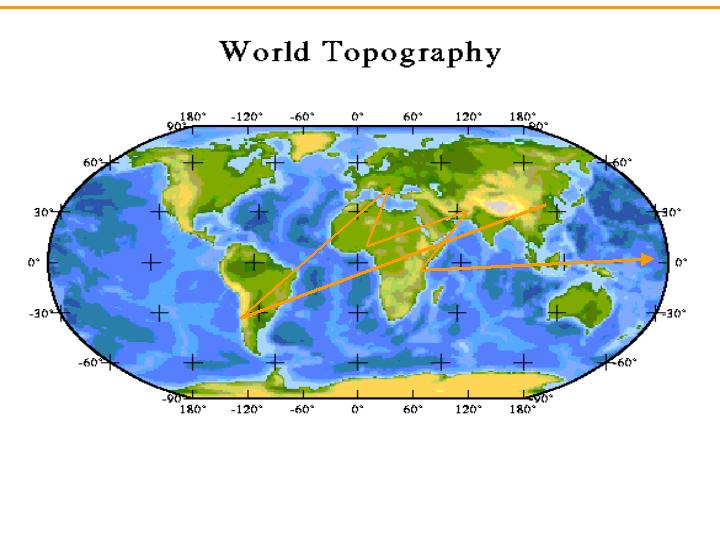
Travelling to Siem Reap

Bangkok Airport – you can get a visa on arrival. But why take the risk? I suggest you get the Thai and Cambodian visas way before you start your journey, to avoid surprises. A Cambodian Visa costs $20 and a Thai one possible about $30. I got a double entry Thai visa because I needed to land in Bangkok first and cross to Cambodia by land and then return to Bangkok again. On that leg we flew from Phnom Penh to Bangkok, stayed there for a couple of days and then flew Indian Airlines to Chennai.

Right after immigration in Bangkok, you can pick up your baggage and head out through the green channel of customs assuming you have nothing to declare. Immediately to the left of the exit you’ll find at least three forex places where you can convert your currency to Thai Bhat. Right now, 1 USD is about 38 Thai Bhat.

On collecting your forex, IGNORE everyone who accosts you within the airport building, and head outside. You’ll find a public taxi stall, which is safer and better controlled.

Tell the guy at the counter you need to go to Mo Chit Bus Terminal and he’ll hail one of the dozens of cabs waiting and get you on the way. Mention clearly – Meter Taxi. The minimum is 35 baht. You will find that the meter would say about 100 bhat when you reach Mo Chit. You need to additionally pay 50 baht to the driver for the airport tax. On the way from the airport is a tollway that you can choose to take or not – the cab driver should ask you. He will ask you to pay 20 baht at that point.

That means that the journey from the airport to Mo Chit should have taken you about 170 Thai Bhat.

Once you get there, go INSIDE the building on the ground floor and proceed to counter 31 for the Aranyaprathet buses – this is the last town just before the border crossing into the Cambodian town of Poipet. There are counters outside too with about the same numbers, so it’s easy to get confused. Your ticket to Aranyaprathet should cost about 200 bhat.

The journey takes about 4 hours in a comfortable bus on smooth roads..

Let's assume you reach Aranyaprathet in the late evening or even at night. Head straight out of the bus station exit where you’ll see a few tuk-tuk guys waiting to pounce on you.

Your best bet is to ignore them if you are backpacking, as we did, and head due LEFT along the main road. After a longish walk of about 15 minutes, you should reach Hotel Thupthonckum (037) 21679, a large white building on your right.

The rooms are okay for the purpose and they have an adjoining little restaurant. We paid 300 baht for a double bed room.

Head out by 615 AM to the border crossing to the Cambodian town of Poipet. The tuk tuk will demand 80 baht or so; negotiate for about 50 to 60. In these areas, negotiation is expected as part of the protocol and you will hurt yourself by agreeing to the first number you hear.

You should get to the crossing BEFORE it opens at 7 am. There is always a huge crowd waiting to scramble across, especially small traders from Cambodia and quite a number of Thais. But do join the Foreigners queue to get your Thai visa stamped and get waved across to the Cambodian immigration which will be on your RIGHT.

I hear Cambodian visas are easy to get at the border, but again, why take a chance. Get it before hand. Cambodian immigration seems to be modern and fairly fast. Once you are through, keep walking till you reach a small traffic island/circle. There is a free shuttle bus available to take you to the government transport area from where you should take a shared taxi to Siem Reap. A friendly Cambodian Tourism authority guy helped us to get there – free - and even put us in a shared taxi without cheating us - but that might have been our luck, so don't trust anyone. Shared taxi to Siem Reap should cost between USD 10-15 per person, or 45 for the whole taxi.

The road is extremely bad and you can be assured of at least one travel-sick co-passenger before you are through.

Though the shared taxi guy says he will drop you to your guest house, he may mysteriously say on arrival at Siem Reap (after 4 hours) that he has never heard of that place. Insist that he call them and they send their tuk-tuk guy before you exit the taxi and hand over the stub of your receipt to him (he will need that to get his money from the boss in Poipet). We stayed at a wonderful place called Garden Village (gardenvillage@asia.com (Ref: Pohin, the manager). (855) 12 21 73 73. The country code for Cambodia is 855 and the mobile network code in Siem Reap (See-em Ree-aap) is 012. We paid about $7 per day for a large Cambodian style simple guest room with attached bathroom. Here is what it looked like:

Ticket to Angkor Vat - $20 per day or $40 for 3 days. A photo is required, so take along plenty or you will have to pay quite a bit for local service. The sequence to visit Angkor Vat is usually this way

Day 0: PM: ticket formalities and issue of an ID card. Sunset at Phnom Bakhen.

Day 1: Bayon/Baphuon/Phimeanakhas/Palace of the Leper King/Terrace of Elephants/ Angkor Vat in the afternoon/evening

Day 2: Banteay Srey, East Mabon etc

Day 3: Phrea Khan etc.

Do not travel to Angkor Vat if you have a problem with heat, are not in good enough physical condition to walk very long distances in the heat and do not like heights. The stone steps in most temples are only about 6-8 inches across and ascend at a terrifying angle of 70 degrees or so. One slip and you’re gone.

Phnom Penh – I strongly recommend The Boddhi Tree which is very well run and conveniently located. Its better that you make a reservation earlier. Get off the bus at Sisowat Road and get a tuk tuk to take you for $1 to The Bodhi Tree. We managed to get the fattest Tuk Tuk driver in Phnom Penh, a Mr. Mel Toy - a very nice man. Here is information you might need about the Bodhi Tree

50 Street 113 - Phnom Penh
Tel: (011) 854 430;
boddhitree_pp@hotmail.com
http://www.boddhitree.com

Avoid Dera Reang Seay Hotel, where we stayed the first night. Its absolutely horrible, though recommended by the PP Hotel Association or something. We ran out the very next morning and paid exactly the same amount ($10) for a much much better place (shared bathroom though with three other rooms).

A generally good idea is to hire a Tuk-Tuk for about $7 - $10 for the whole day. Always bargain.

Phnom Penh is a small town. To get from one place to another by a tuk-tuk should cost between 200o Riells to 6000 Riels (1 USD is about 4000 Cambodian Riels).

There are two main and busy markets in Phnom Penh - the old one Psar Thmey and the Russian market. You can get a lot from either of these places doing some fierce bargaining and being willing to walk away. We bought a Ta Khei, a traditional Cambodian instrument from the Central Old market.

There is a decent Indian Restaurant called Madras Cafe near the old market. Vegetarian options are few in Cambodia. Do not go by the recommendations of Lonely Planet in this department for sure. They have recommended a lousy place in PP which serves amazingly bad food.

Tuk-Tuk to the airport will cost you a standard $5 fro practically anywhere in PP. The airport is clean and modern and everything there is quite impressive. There is a $25 airport departure tax to be paid. Its 500 Baht at Bangkok.

Check out Air Asia for bargain deals ($10) between PP and Bangkok.

Wednesday, May 31, 2006

The Deep Sea and You


The moon has waned today

to a mere speck of grey light
draped by red restless clouds

The salty winds in my town
near the Sea of Japan
punctuated
by your dark screams
As I bite into your dreams
tasting the purple blood
of eternity.


Who hears them?


The mermaids have slept

In the dark green kelp
that floats for ever
and muffles your cries


The whales have gone away
with the currents
thinking sweet thoughts of your pain.
They shall be back next year
succulent bits of them
on your plate


The Octopii have descended deeper
All arms flailing
pretending to be you
As you try to die

In the morning
there shall be no blood
on those clean white sheets


Merely the impossible aroma
of the deep sea.

Thursday, May 11, 2006

Odd Haikus


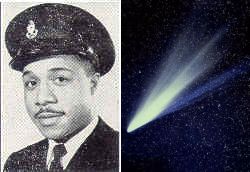
Heroes of the past
Come, Thor, to Alabama

the stench of beauty


Comet; Seventy Six Years
Did Haley ever see you fly?

From Roots
to Black Holes


Bidpay of Turkey
Capn Scott "It seems a pity"

London Library


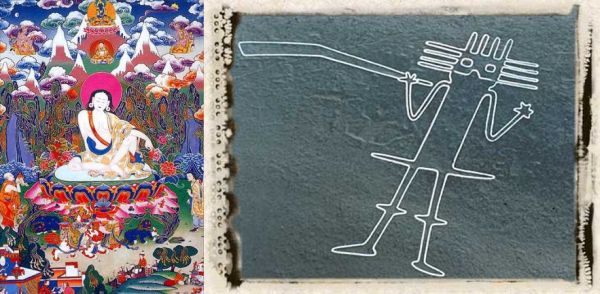
Nascas of Peru
A grim pale Love in Dothan

Milarepa smiles


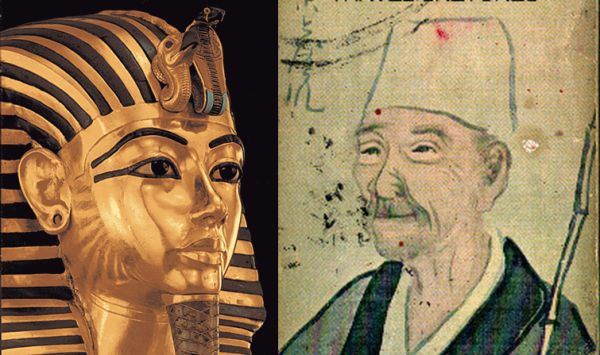
He, Tut Ahn Kha Mun
The black-ink pot of Basho
Pyramids, a waste

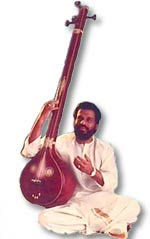
A Concert by Yesudas


I attended an EXCELLENT concert by the great K J Yesudas yesterday at the Fort High School in Chamarajpet, as part of the ongoing Ramanavami Celebrations.

Most of you know of Yesudas from his playback singing in movies.


Listen to a couple of Hindi songs


Ka Karoon Sajani

Madhuban

In fact, he is an outstanding classical Carnatic musician. The concert was electrifying. No fuss; a charismatic and highly energetic person. Perfect selection, not a single note out of place and a charming simplicity that endeared him to all.

A couple of Classical Pieces


One

Two

I was thrilled by the subdued high-quality accompaniment - Mridangam and Violin. Unlike the average modern Hindustani recital where the accompanists battle for coverage, Carnatic concerts still seem to have restrained accompanists.

He started with a famous Nava Raaga Mallika composition by Patnam Subramania Iyer (of which I have a recording of when I had played at a concert when a boy, accompanying my Guru; a sudden thrilling memory). He sang Kanakangi - a very difficult Raaga - a composition by Thyagaraja. Others that I made notes of: Purandaradasa and Thyagaraja compositions etc etc. One more nostalgic piece was Yenta Velu Kundu Raghava, which my Great Grandmother taught me.

Yesudas was a student of the late great Chembai Vaidyanatha Bhagavathar.


There are a few stories about him being denied entry to the Guruvayoor Temple because of his religion and also that his own Christian community sub-sect wasn't pleased with him for singing "Hindu" compositions. Nevertheless, he has today established himself as a five-star classical singer.

The mixing of musical genius in South India is worth mentioning.

Thyagaraja was a Telugu Brahmin from the present Andhra Pradesh. He settled in Tamil Nadu in an area ruled by Maratha Kings. The Tamil community today are truly torchbearers in singing his Telugu compositions. Purandaradasa's works in Kannada are also part of this Carnatic tradition adopted by all hues of musicians.

For that matter, Kumar Gandharva, so famous in Hindustani music, was from a Malayali family that had migrated to North Karnataka (please correct me if this is an incorrect hazy recollection)

Kerala has contributed a great deal to Indian traditions, without question. One recalls the great Swati Tirunal, Maharaja of Travancore, who made a name for himself as a composer and musician. The Palghat Brahmin community has many musicians.


And otherwise, Sanksrit scholars abound in Kerala. The priests at the Pashupati Nath Temple in Nepal are traditionally from the Namboodiris of Kerala. And so is the case at the Badrinath Temple - I could be wrong. Just some trivia.

Anyway, hat tips to Jesudas. What a guy! A great and memorable evening!

Sunday, April 23, 2006

Phnom Penh to Bangkok for $10!


Yes

I have purchased a ticket on Air Asia from Phnom Penh, Cambodia to Bangkok for $10.00 Ten.

But Taxes are another $19.50!

And Airport Departure Tax is $25.00!

I think I still have good deal. What do you think??

Friday, April 21, 2006

Effective Proposal Writing

Ahhhh...well, signed a lucrative multi-million dollar contract for my book "Effective Proposal Writing" with Sage Publications.

Thanks to all who helped me!

did I say "Multi-million"?

Disregard that totally! :-)

Monday, April 17, 2006

Two Concerts

After a very very long time, I attended a concert. Not one, in fact, but two.

The first- on Saturday - was in honour of the KC Das centenary. It started with a bang with us meeting the great Manna Dey himself and taking his autograph!! Wow!!

Then followed the inevitable delays and we finally came to the music.

Here goes.

First we had a young lady sing. She sang very well indeed. Oddly she did not sing any classical stuff - well, maybe a bhajan or thumri or so. She was accompanied by some other fellow (her husband?) on the Harmonium who was loud and painful. More on this fellow soon.

Then followed pain and misery. The daughter, a cute little thing, all of 4, was forced to sing Miyan ki Todi and Mian ki Malhar. Why?

The great man himself sang. With two tanpuras, a tabla, a harmonium and a swarmandal to help drown out his voice, he launched into an extended torture session. First he gave the usual spiel about how the great Gurus had blessed him etc. Absolute rubbish and fake nonsense. Then he sang a blood-chilling version of Jaijaivanti, a proper rendition of which, by Faiyaz Khan, is here.

IT WAS HORRIBLE, NAKED NONSENSE.

Unfortunately, due to his obsession with himself and his family, he cut into the time of the brilliant and rather unassuming Sitar player Kushal Das, who's been mentioned in my entry about Todi. Here is his Bilaskhani Todi again. Superlative is not the word.

He played Rageshri and then Pahadi, examples of which are here and here. I loved his fluency and brilliance. No nonsense and in very very sharp contrast to the other clown. He gave no speeches about God's divine blessings. He just did what he had come to do. I was thoroughly impressed and the prior torture was worth it. I felt furious that I could listen to Kushal Das for such a small period of time, just because of some idiotic megalomaniac.

On Sunday, Sarang and I went to Fort High School to listen to the Ramanavami Music celebration concerts. The concert started an hour late. It featured Mysore Manjunath on the violin and Vishwa Mohan Bhatt on the guitar. They played Charukesi. It was technically brilliant but it lacked soul; it was played on predicatable lines and did not have the gravity and softness I was hoping for. They might as well have played any other Raaga. Mostly histrionics. I was more impressed by Mysore Manjunath than Bhat. His bowing was simply wonderful!!

We left after a while and did not listen to the rest. Perhaps it was nice...

Wednesday, April 05, 2006

A Bunch of Haikus

Elusive friends in
Many Capitols Unearthed
Koto in Maryot


Stratocumulous
a gray sky fails to becloud
March Friendship unseen

Distortion reigns on
friendship in a foreign land
The ethernet's quiet


The trees bend low
Leaves melt in the heat
friends in shadows

softly silent mind
A cold winds murmurs, afraid
Lost Samurai


A Cold Rising sun
Haunting are the Gulfstream Blues
a quixotic vanishing

My Koto's tunes jar
strings untaut rust patina
missing friend; come back


Far in Sapporo
DC beckons brutally
a good heart beats on

A Written poem
An Invisible Inkdrop
An Eternal clasp


A hot sun blazes
Cold is my heart, but alone
Your call I await

Children in a bed
Here I breathe strange lonely air
A good friend comforts


Blue Moon; A dog howls
Silent night an odd strange land
Safe Viriginia

Of Vicissitudes
Many aborted meetings
a cold barren heart

Pure is my Promise
Lincoln, so near yet so far
Torture Chronicles

Silently arrive
metal wings across cities
Breakfast is burnt toast


Who is Vasudev?
sad to see a doubting friend
Bald crow in winter

Accusations hurt
many contrite shrinking hearts
White House is quiet


public scorn of pal
prurient analysis
a calm lake disturbed

sorry, snarling friend
scared Japanese; a koto
dry autumn in spring


Hotels without walls
a sweet internet friendship
koto falls silent

Raging Potomac
Apologies for trouble
The Art of Living


A final goodbye
old age, perhaps a meeting
Glacial melting

Music in tune with the Divine

Music in tune with the Divine

Vasudev Murthy

First Published in the Deccan Herald on August 30, 2005

Image hosting by Photobucket

Thyagaraja's inspired dialogue with a benevolent God, via music, is made more believable because of what we know of his simple lifestyle.

Just as the music of Tartini and Paganini was believed to be inspired by the Devil, there are other kinds of music that have strong religious connotations; melody, harmony and rhythm have been used to persuade invisible powers to shower grace and favours on a person or persons. Martial music is perhaps an exception. However, even military tunes have a purpose - to enthuse, to motivate and to convince soldiers or a nation that righteousness was on their side and the forces of darkness would shortly be annihilated.

Sarangadeva

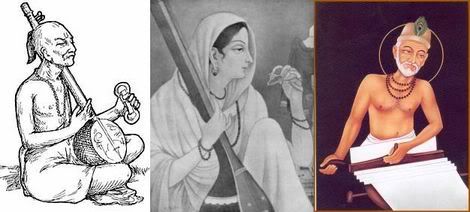
Indian music has been blessed in many ways. Apart from the rigour of a grammar and taxonomy in both major streams of classical music via Sarangadeva and Venkatamakhi, the religious traditions of the country have sparked musical creativity to the extreme. Most examples are well known. Surdas of the Bhakti movement found inspiration in the life of Krishna to burst forth into song. Mira Bai was obsessed with Krishna and created bhajans spontaneously. She and Kabirdas were major figures of the Bhakti movement. Except perhaps for the period of Aurangzeb who frowned on it, music and religious dedication have been respected in India for centuries, and virtuosity has been admired rather than looked upon suspiciously.

Surdas Mirabai Kabirdas

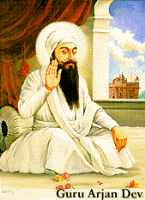
A lesser known example of the tight bond between classical music and religion has been in the Sikh tradition. Guru Arjan Dev, the Fifth Guru, set the entire Guru Granth Sahib to about thirty different classical raagas. Knowing how the mind reacts to various raagas, he took extreme care while choosing them.

Image hosting by Photobucket

The lessons of the Granth Sahib thus prescribe correct behaviour and clean living through music; this is not imagination -- the feeling of elevation and the desire to do good does take shape if you listen to well sung shabads in certain raagas - try Ramkali, for instance.

Guru Arjan Dev was obviously gifted and understood group psychology and the power of music in shaping religious sentiment. This effect is seen elsewhere in choir music, bhajans and qawwalis alike, where the musicians and the audience collectively enter some kind of a rarified collective mental state for a period of time. This mass demonstration of piety via music is intended to inform a compassionate entity (God) of their devotion to Him.

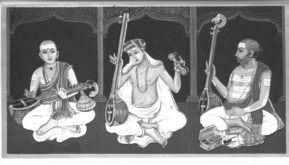
And not too long ago, while Paganini was being looked at jealously in Italy, Thyagaraja (1767 -- 1848) performed musical miracles and composed hundreds of kritis across the entire complex spectrum of Carnatic raagas. Whether he was extremely pious and was consumed by the need to see Rama and therefore composed so many kritis or whether he was musically gifted anyway and found bhakti to Rama as a perfect channel to vent the music is a pointless debate. An obsession with his concept of the Supreme combined with musical genius gave us expressions of immense musical creativity which are unlikely to be ever surpassed. Thyagaraja was lucky - and so were we - that the social environment he lived in - Thanjavur in this instance - respected music and he was given recognition while he lived. He had exalted company - Muthuswami Dikshitar and Shyama Sastry lived in the same area at about the same time - and was sufficiently motivated to enhance his genius.

Dikshitar Thyagaraja Shyama Sastry

Some people are tone deaf while others are believed to have a perfect ear for detecting variations in music. But generally, the range of audible frequencies means that our musical experience is limited by the construction of the ear and the etrainingf that our neurons receive over years - and occasionally genes. In our tradition, we also speak of anahat - the music that cannot be heard except by the spiritually exalted. We would like to believe that many geniuses derive inspiration from an unknown benign source because the extent of their musical experience is beyond the normal and they can perhaps access the anahat due to 'spiritual purity' or, at any rate, some peculiarity.

A Thyagaraja Composition
A Muthuswami Diskshitar Composition (Veena)
A Shyama Sastry Composition (Violin)

Thyagaraja is no longer available. His inspired dialogue with a benevolent God, via music, is made that much more believable because of what we know of his simple lifestyle and true rejection of the material world. It is fashionable today for modern musicians to refer to their 'divine' experiences and to mutter some intelligible shlokas, while having a keen eye on economic benefits and possible felicitations and awards in the pipeline. It is rare to find 'inner peace' in most of today's concerts, though one might find technical perfection and even a pleasing experience.

What set the music of - for instance -the late MS Subbalakshmi, Nikhil Bannerjee and Pannalal Ghosh apart was a definite element of inner contentment in their music and a distinct lack of interest in playing to the gallery. They communed with an invisible world via music while they were alive. Their music leaves clues to us about the Great Beyond.

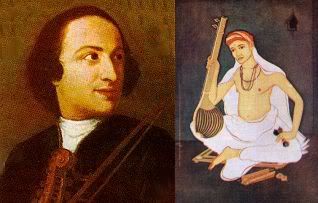
Tartini Thyagaraja

Tartini and Thyagaraja. One spoke to the Devil and the other to God. And music was the language they both chose.

--------------------------------------------------------------------------

More links:
Here is a link to a Sikh Shabad in Ramkali

Some more classical pieces
One
Two
Three
Four

Tuesday, April 04, 2006

Utopia Today - Reality Tomorrow

Image hosting by Photobucket


I am most delighted to inform you that my story-essay on the 'Universal Declaration of Equality of Species’ figures in a new publication

'UTOPIA TODAY - REALITY TOMORROW - A vegetarian world'

Here is the blurb

The European Vegetarian Union is happy to announce that the book is now available!

Thirty five authors - nutritionists, medical doctors, authors of bestsellers, founders of important organizations, researchers, IT-specialists, philosophers, sci-fi fans, musicians and talented individuals - generously contributed to this EVU fundraiser project. The authors come from a variety of countries, cultural backgrounds and religions but they all have one thing in common: the conviction that a more compassionate world is not only possible but inevitable if humanity is to prosper.

I invite you to take a look at more detailed information here.

Other names you may recognize in the list of contributers include Ingrid Newkirk of PETA, Alex Hershaft, Mark Bekoff and Neal Bernard (President, Physicians Committee for Responsible Medicine)

136 pages, 35 authors from 11 countries, ISBN 3-909067-05-0

This is not about ME. So rather than congratulate me, please do spare a thought for those who cannot express their suffering and live out a life of pain and misery.

The Violin and Devilish music

Published in the Deccan Herald on August 29, 2005


Note: I have provided very small music samples here to illustrate a point or two.


The Violin and Devilish music

Image hosting by Photobucket
By Vasudev Murthy

There is no culture that has not developed music in some form. The general stress on harmony in Western classical music, where multiple notes might play together for a pleasing effect, is not pronounced in Indian classical music, which is more preoccupied with the importance of single notes within a larger sequential context. Japanese gagaku, Korean hyangak or traditional Icelandic music might sound strange to those accustomed to something else but it works for those who live in those countries nevertheless. Each culture needs to produce music for whatever reason.

Various parts of the brain apparently work together in the understanding of melody, harmony and rhythm. Classical music in particular stimulates those parts of the brain that deal with mathematics and spatial reasoning. Those who are musical seem to have an intuitive grasp of mathematics (though - empirically - the converse need not be true) because of the need to process variations in pitch and time.

But science apart, music's peculiar agony is that it thrills and troubles us. Why do we like music? Why are some better at it than others? Why does it drive us mad, motivate us, or cheer us up?

The desperate need for man to want to believe he is not alone in this Universe and has some kind of a benevolent figure or figures watching over him, picking and choosing acts of good and evil, punishing and rewarding and generally keeping an idealistic sense of order has developed the institution of religion.

The effect of music has long been interpreted as a means of communicating with the unseen and unknown. It is no wonder that classical music everywhere has strong roots in the devotional or meditative side of existence - and not always in a positive way.

Music (and even dance) causes a peculiar ecstasy or disconnect with the immediate world and is interpreted as a spiritual flight of fantasy. Whether Gregorian chants or bhajans, Dhrupad or the recitation of shlokas, Buddhist chants or Turkish Sufi music -- the cadence of religious music acts as a pleasing soporific and a temporary escape into a personal mental space that is satisfying because we are trained to believe we are close to the supernatural at that time. The Voodoo ceremonies of the Caribbean, as another example, consider music and dance as an expression of a connection to the spirit world.

Image hosting by Photobucket

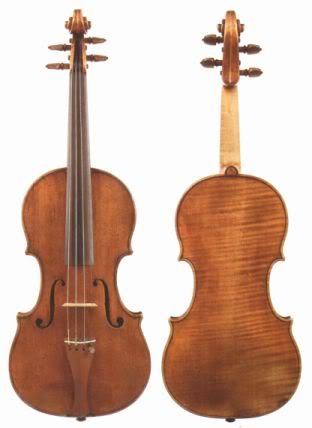
The violin was considered an instrument of the Devil and blamed for all manner of abnormal behaviour. Nero continues to be falsely accused of having fiddled while Rome was burning - implying perhaps that he was so absorbed in playing the violin (which hadn't even been invente then, by the way) that he was impervious to everything else around him.

Used as an accompaniment to dance in Europe, the violin was condemned as being a catalyst to bad morals and an agent of the Devil.

Image hosting by Photobucket

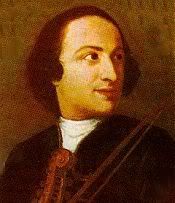
Giuseppe Tartini (1692-1770), then the violin's greatest virtuoso, is credited with the Devil's Trill or Devil's Sonata. He claimed that the Devil played it for him in a dream.

Image hosting by Photobucket

I heard a sonata so unusual and so beautiful performed with such mastery and intelligence, on a level I had never before conceived was possible! I was so overcome that I stopped breathing and awoke gasping. Immediately I seized my violin, hoping to recall some shred of what I had just heard - but in vain. The piece I then composed is without doubt my best, the Devil's Sonata, but it falls so far short of the one that stunned me that I would have smashed my violin and given up music forever if I could but possess it.

The Devil's Sonata is indeed quite bizarre and does seem supernatural. Tartini's other work does not resemble this piece at all! One speculates ... when normal dreams are so strange and so quickly forgotten, is it impossible that one hears music in them?

Image hosting by Photobucket

Niccolo Paganini (1782-1840) was another brilliant violinist who was under suspicion because his virtuosity was just a bit too unbelievable. He handled the violin like a toy and could do things with it that no one else could even dream of. The German poet Boerne, after hearing a concert by Paganini, said: 'It was (a) heavenly and diabolical enthusiasm'.

Many believed he was the Devil himself and it did not help that he had dark hair and a pale face. Mme Blavatsky's chilling story, The Ensouled Violin, talks about a violin teacher's determination to have his student get the better of Paganini ('It was rumoured that the strings of his violin were made of human intestines, according to all the rules and requirements of the Black Art') in a duel. He sacrifices his life and forces his student to use his guts as the violin strings.

The story ends with the wraith of the violin teacher rising from the student's violin (His viscera were protruding and the ends of the intestines stretched on the violin). For his pains, Paganini was not allowed a religious burial when he died. His music was not Godly enough - it was too devilish.

Image hosting by Photobucket
End of Part One

Monday, April 03, 2006

Todi: Soul Food for Ascetics

Warning: I am not a musicologist. I am just interested in music. Do not quote me or act based on the information available on this page. You can collect and collate information in the same way as I have. These are from public sources such as sarangi.info, itcsra.org, musicindiaonline.com and others. This is only an indicative article and I do not claim its correctness or its completeness. I don't want credit for anything. Thank you.


Image hosting by Photobucket
For my Excellent Friend in DC, David Raphael Israel


TODI


Soul Food for Ascetics

The Raagas of the Todi Thaat (Root) are regarded with much apprehension. Extremely hard to handle by most musicians, especially instrumentalists, it is also not the easiest to fully unravel by the listener. One practical reason is, of course, that the Raagas that owe their existence to this Thaat are all executed in the morning when most concerts are not scheduled anyway. Thus the rarity.

As a result, names like Khamaj, Bageshree and Bihag etc. are far more familiar as they appear in the evening/night when people are possibly more disposed to relax and listen.

Highly cerebral and intellectual Raagas like Todi do deserve much more than a cursory glance. Two quick appetisers - here and here.

Image hosting by Photobucket

Todi is highly reflective and meditative. We visulize a merging with a greater consciousness, an endless time, fleeting and evanescent life-blips. I am aware of one musician who was sucked in so badly by this Raaga that he possibly went mad. The shades and depths of this Raaga are not for the timid.

They emphasize, in my mind, a stern and uncompromising internal focus on something elusive but clearly present. In short, the soul.

Image hosting by Photobucket


The Todi for Hindustani Classical corresponds to Hanuma Todi of the Carnatic school, whose Todi is different. I digress.

Image hosting by Photobucket

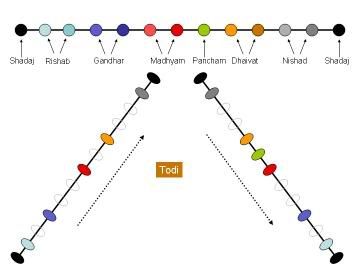
This figure explains the strange undulations of Todi in the ascent and descent. The symmetry is broken by the unexpected and delicately introduced Pancham. An analogy might be the Teevra Madhyam of Yaman which is conspicuous by its sparing use. The determined non-usage of Pancham results in Gujari Todi, which also has a different lilt. But it is not as easy as that. If it were, the mere removal or addition of notes ought to result in millions of new Raagas. This is not true; some combinations are indeed considered 'unmusical'. The manner of exposition is also important. A fast Bilaskhani Todi will sound jarring without a proper buildup or a slow Brindavani Sarang is meaningless. Or a Nand without adequate interspersing of silence violates its essence, though it may sound okay.

Image hosting by Photobucket

Another simply classic example: the Sarangi of Munir Khan.

Here you have Faiyaz Khan singing Todi.

A much longer version by Parveen Sultana is available here. If you listen carefully, you will find a few errors, which merely shows how difficult this Raaga is, and not necessarily the caliber of the artiste. These things happen.

Bilaskhani Todi is a misnomer, though understandably so. It technically belongs to the Bhairavi Thaat. It's pathos must be remarked upon. The story is that as Bilaskhan, the son of Tansen, created this Raaga at the funeral of his father. You are unlikely to find a more brilliant example than that of the late Pandit Nikhil Bannerjee's Raga Records production example (no audio here, sorry).

Here is a beautiful example, otherwise, by his student Kushal Das.

What marks the special searing pathos of Bilaskhani Todi? First is the missing Madhyam on the ascendent, and the pair of Gandhar and Pancham. Further, while ascendng, if Madhyam is touched, a descent is forced. And then the quadra-set of Dhaivat, Nishad, Nishad and Madhyam. Odd? Hmmmm... that is the soul-disturbing pain of Bilaskhani Todi, an extremely moving
Raaga. Here is Amir Khan.

Image hosting by Photobucket

From an unknown manuscript, unlikely to ever see the light of day, Bilaskhani Todi speaks as the flames in a pyre:

As we lick this pyre singing Komal Rishabh, we wonder at our task. As we creep over his body, we peep at his face and reach for the Pancham in exclamation, astonished at his nobility. Yes, he knew us, your Father, and now we know him.

Komal Rishab Asavari Todi. The challenging Raag derives its name from the use of Komal Rishab rather than the Shuddha Rishab of Asavari. Asavari is another Thaath from which Raags like Jaunpuri, Darbari and Adana emerge. You'll like this.

Some argue forcefully that it belongs to the Bhairavi Thaat. These little differences make for enjoyable analysis.

Bhupal Todi is merely Todi with the film of Bhupali overlaid. Specifically, the removal of Madhyam and Nishad. Thats the mathematics, but, as explained previously, that doesn't suffice.

Here are two more important variants.
Bahaduri Todi Mallikarjun Mansur uses both Rishabs with gravity and care. You will also find both Madhyams, the lower an accent from Bilaskhani Todi. Not for the faint hearted.

And Gujari Todi

Here you have a lovely piece in Todi by Abdul Latif Khan. Worth many listens.

Asa Todi, or just Asa, is a rarity mostly found in Sikh Shabads. I found a nice one by Bhimsen Joshi. It is a blend of Asavari and Todi.

Two relatively popular Raagas that derive fom Todi are Madhuvanti and Multani. Multani is restless, while Madhuvanti is sweet. Multani shares the notes of the base Todi, while Madhuvanti deviates in the use of Rishab. One may argue it does not belong to the Todi Thaat

Here is a Sarangi piece by Nathu Khan in Multani

And here is Inayat Shah on the Dilruba playing Madhuvanti

We end with this Todi and here are Ustad Bismillah Khan and the late Pandit V G Jog (who explained Todi to me and a young Dutch violinist so many years ago in a small room in Kolkata, which we then played together somewhere and made a mess of.)

Enrich your lives and those of the next generation now! Listen to Indian classical music!

Cordially and Goodbye.


VM

Image hosting by Photobucket
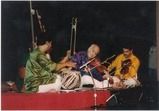
The late Pandit V G Jog in concert accompanied by Anand Gopal Bandopadhyay on the tabla. That's me in the yellow kurta.

Monday, March 27, 2006

Bhairav and Beyond


Image hosting by Photobucket


Bhairav and Beyond


This little piece is dedicated to the charming Anoushka Thakur, who left JJ and I with moist eyes after her much-too-brief visit to Bangalore. We bless her that the music in her takes tangible form and illuminates the world some day.


The high-point in our rapidly dying culture has been the exalted status of classical music. Due to the forbidding aura of unfathomable secrets that surround it, many abandon its exploration even before they start, a grave loss for future generations. May I suggest boldly approaching this mental barrier and making a small effort to cross it to get a glimpse of the wonders available to us for the asking.

The Raaga Bhairav has highly esoteric connotations. It may be considered the primordial musical scale in many ways. It is precisely the same as the Carnatic Raaga Mayamalavagowla.

A simple description of the musical elements of Bhairav is here.

All seven notes exist in the ascendent and the descendent. Technical analysis fails in the face of practical considerations. Never mind. Associate if you will, for a moment, Bhairav with Shiva. Bhairavi then associates with Parvati. Bhairav is deep and calm, and subdues the restless mind. Bhairavi adds to restlessness due to its stimulation of many musical patterns born within us. But I digress.

Here is Bhairav by Rashid Khan. Notice the particular quality of the percussion heightening the mystical quality of Bhairav.

Bhairav contains the note Komal Rishab. Easing into it or leaving it requires the exercise of gray matter and deep respect. The note must stand alone and linger and not sway to the extent possible. Thats just one view (mine) and others may differ. And they may be right.

A certain little-known book in fact claims

This note, this Komal Rishab, is the sound of peace across the Universe.

Later, we find

All Raags come from me. I permit them to exist and I finally destroy them. From me springs
Bhairavi, intoxicating, permitting every emotion to express itself through her. She is my mate, my Ardhangani, my half, but only because I allow her be so. I am the ultimate expression, seeking neither approval nor even acknowledgement of my existence.

Imagine that!

Bhairav is a Thaat (root) too. That means there can be hundreds of variants that owe their existence to Bhairav.

Here are some:
The deviation of Nat Bhairav in the use of Shuddha Rishab is a pleasure. Here you have a sample.

Closely aligned is Charukesi, borrowed from Carnatic music, with a deeper touch of pathos, achieved by the use of Komal Nishad and the stress on Shuddha Gandhar.

Ahir Bhairav and Nat Bhairav are twins, in my raw mind. As a violinist, I see it vividly on strings, but its difficult to convey. The swapping of Shuddha and Komal Dhaivat and Rishab notes are best illustrated by demonstration. For that, I invite you home for tea.

The sheer dignity and classical depth of this Raaga and its derivatives should be enough to calm the soul of the most troubled by speaking of eternity and illusion. I highly recommend it.

All hail English Literature lovers and critics! Send constructive suggestions my way!

I must point out that all sources are freely available in the public domain. I have done nothing special here. You could do the same if you are so inclined.

Do note that I am no expert; I freely accept that I am a novice. For a much better analysis, I refer you to Rajan Parrikar's page here.

Monday, March 20, 2006

The Song of Oluadah


The Song of Oluadah


Said Oluadah's Father:

Oluadah! Oluadah!
My son, my son!
Where are you?
Who took you away?
Oluadah! O Oluadah!
They say a white man dragged you away
and you walked on the water
and went away.
Say it is not true
Oluadah! Oluadah!


Said Oluadah:

Father! O Father!
I do not wish to say Goodbye
My children must know you
and I do not wish to go away
What shall I tell these men, O Father?


Said Oluadah's Father:

Oluadah! O Oluadah!
My son!
I wish to see your children
and their children
I wish to stroke their eyebrows
I wish to hold them to my chest
Do not go, my son!
Do not go!
Oluadah! Oluadah!


Said Oluadah:

Father! O Father!
They say I shall go to Savannah
They say I am worse than the dog
who died of sores in the village
These chains hold me to the wood
and I rock with the water
Can I not drown, O Father?
Can you not teach me how, O Father?


Said Oluadah's Father:

Oluadah! O Oluadah!
Come back my son!
Your mother grieves, your sister cries
The village is dark
Your friends dash their heads
against silent trees
asking for you
what shall I tell them, Oluadah?
What shall I tell
the leaves and the birds, Oluadah?


Said Oluadah:

Blood stains the rocking wood, O Father
So many die,
so many wish to die
I can hear them throw their bodies
and the sharks feast lazily
And ahead of us, I can hear
the sharks swim
waiting for my unborn children
Where are you, Father?
Where are you?


Said Oluadah's Father:

Oluadah! O Oluadah!
Come back, my son!
Take the chicken, take the yam
take the ripened fruit
what use are they to me without you?
Oluadah!


Said Oluadah:

O Father!
They have tied a rope
around my neck
They have chained me to the planks
I have died
though they say they shall
sell me alive
No longer shall I see you, O Father!
No longer shall I sleep under your tree, O Father!
No longer shall I eat the ripe yams, O Father!


And you shall not hold your Grandchildren, O Father!


Oluadah! Oluadah!

Friday, March 10, 2006

The Pursuit

Once I said, to Cupid, to Love I was not prone
But those limpid black eyes - ah! from a heavenly zone!
That dusky tone, that silver voice, that Samsung phone
I felt, no, I could not possibly be further alone

T'was clear to all that her alone I loved
With quotidian certitude, my heart gloved
But indifference, and harsh looks that shoved
T'was clearly no deep interest from my beloved

With festering sores, in pursuit to distant shores
My heart bled, but I took up loathsome chores
"Proximity would allow quadrature"; my heart soared
In Beijing, I was caninized to one on all fours

Onwards to Santiago, where she took up a posting
The yaw of my heart, my love I was a-boasting
Peculiar diction I heard, a similitude to roasting
O'er the Andes, my coccyx was sent a-coasting

Undeterred, no ullage of courage, to Albania
This love, this sheer caballine mania
Her dark tresses, beauty and clear megalomania
"Away! Awast!" she spoke sharply, "To Campania!"

Her transfer again to distant shores, to Ghana
I crept in via Air Cargo, feeding only on a banana
"My nacreous love" I crooned, wearing a bandana
The Police, alas, escorted me to a decrepit cabana

Her feelings reached their nadir, in quaint Quetta
I swam there, to be presented by harsh documenta
Gossamer o'er my head, hubris smashed, blood magenta
I did not care; my deep love was still in a fermenta

A promotion - off she was to Dar Es Salaam
I ran after, my pounding heart seeking calm
Hoping finally, her words to my heart would be balm
Alas, t'was with some pain that my cheek felt her palm

Finally it dawned that she wished me in the Marina Trench
I sat, head bowed, on a rusting old bench
I cried, my heart broken by this final wrench
Travels to no avail, desire, who shall quench?

Thursday, February 09, 2006

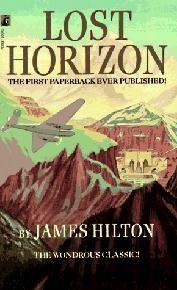
Lost Horizon


Its been a long time. I condemn my laziness and call upon you to condemn it too..

I went back to a book that I had read when a boy. It lingered...the memory...

An elegantly written book, Lost Horizon has much in it to savour and digest. A mysteriously hijacked plane that crashes in a remote part of the world where the process of aging has been practically stalled, some profound comments about philosophy and culture.....a beautifully crafted tale. The exotic Shangri-La - it might exist even now, who knows? We do know of tales of those who claim to be thousands of years old (yes! write to me about that!) and of the mysterious Shambala, a world beneath the surface of the earth.

There is no arrogant preaching here about Christianity, though oddly, an important figure turns out to be a long-lost Missionary who develops a more respectful worldview and absorbs the best of the Oriental and the Occidental.

A touch of mysterious romance, a fugitive, a cerebral and an open-minded laid-back hero - and of course, a twist at the end.

Do read this book. You will thank me.
Thursday, December 29, 2005


Today is my son Sarang's Birthday! He is 11 now!!!
Happy Birthday to a Wonderful Son!

A Whole Bunch of Links

A Whole Bunch of Links about book reviews, my articles, stories, poems and more. Click away.


Review of What the Raags Told Me/Vasudev Murthy. Rupa and Co., ISBN 81-291-0317-6.
Indian Express
Tribune Chandigarh
Deccan Herald
The Hindu
Sruti Magazine

June 2005: My article in RAVE magazine

Articles in the Deccan Herald
-----------------------------
July 5 2005: On Cruelty - East or West
August 6 2005: On the Nagasaki Bombing
August 21 2005: On William McGonagall, the World's Worst Poet
August 25 2005: About the lawyer Jacques Verges
August 29 2005: About Violins and the Supernatural
August 30 2005: Music and Spirituality
September 13 2005: The Music of New Orleans
Nov 21 2005: A Solitary Lamp for Sardar Patel
December 19 2005: Flat Earth

Articles in Vijay Times
-----------------------
Nov 19 2005 Article on Nuremberg Trials
Dec 18 2005 Poem: Give me a Bribe! Cried my MP
Dec 27 2005 Corruption, our new National Religion


Story in Veena Magazine, London Arts Review
God in a Restaurant
Poems: Far Away, The Other Me, etc.

Tuesday, December 20, 2005

Give me a Bribe, cried my MP

This poem appeared in the Sunday Vijay Times in Bangalore on Dec 18 2005


Give me a Bribe!

Give me a Bribe! Cried my MP
I’ll agitate, obfuscate and vitiate
I’ll shout, scream and militate
I’ll fight for the poor,
If need be, in the sewer
But give me a Bribe! Cried my MP

Give me a Bribe! Cried my MP
I need your votes
Though I prefer your notes
I’ll discuss your plight
And just won’t be quiet
But give me a bribe! Cried my MP

Give me a Bribe! Cried my MP
I have to go to court
Because of that First Information Report
It’s expensive flying first class
Though I have my Railway Pass
I’ll certainly ask your query
No need to be leery
But give me a bribe! Cried my MP

Give me a Bribe! Cried my MP
Oh can’t you see
Corrupt I have to be
I have to feather my bed
I just can’t be in the red
Oh it’s so sad!
I feel very bad!
But Give me a Bribe! Cried my MP

Give me a Bribe! Cried my MP
It was just a ‘bhool’
Do you take me for a fool?
If I must rule
I really must be cool
Be that as it may
And say what you must say
But Give me a Bribe! Cried my MP

Give me a Bribe! Cried my MP
You may think I’m a louse
And that I’ve brought disgrace to this and august House
It may be that I was caught
But frankly, so many were not
Anyway, there’s absolutely nothing you can do
Feel free to rue
But Give me a Bribe! Cried my MP

© 2005, 2006 etc V M

Monday, December 12, 2005

Smell of an Evening

Suresh Menon's collection of short stories, Smell of an Evening, a publication of Yeti Books, was released at the British Library on the 10th of December at a small but tasteful function.

Yeti Books has been doing a good job in producing very decent books - content quality as feel as production. Thachom Poyil Rajeevan is the man. A real cool guy with whom its a pleasure to have a few drinks and laughs. I think his poems are hot stuff.

Suresh is a decent guy, Foreign Editor for a Business paper in Singapore. Its good to make good friends with whom we can be natural!